Tag: kumaraguru institutions

  • Leverage the ‘Orange Economy’ to Drive Change: Rajan Navani Urges KCLAS Graduates

    KCLAS graduation
    Kumaraguru

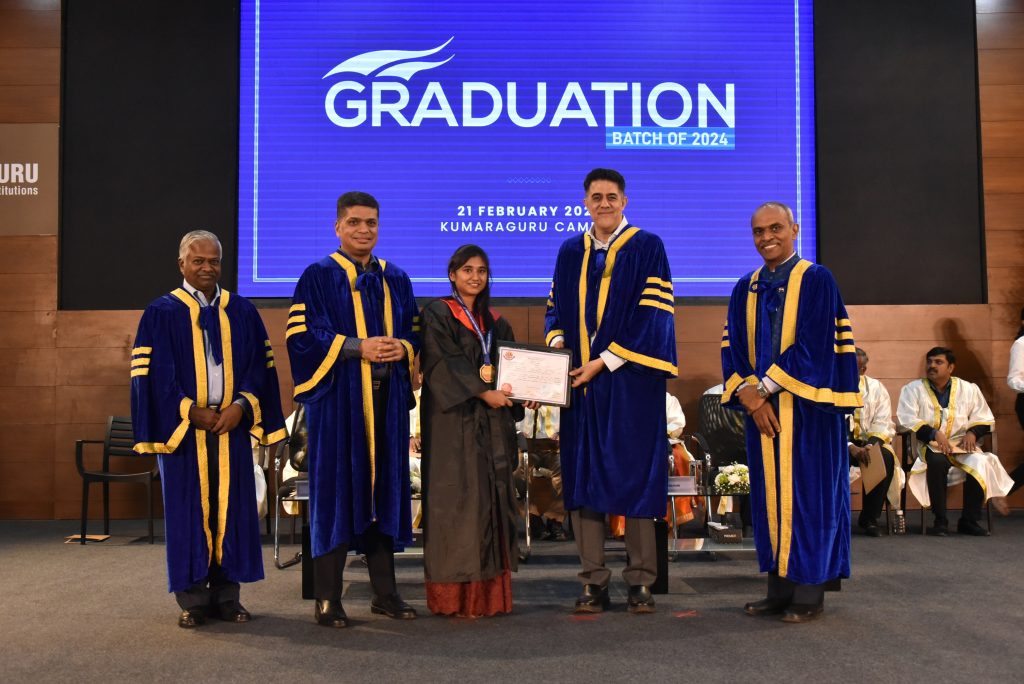
    Kumaraguru College of Liberal Arts and Science (KCLAS) hosted its 4th Graduation Day Ceremony for the Batch of 2024 (UG & PG) on 21 February 2026 at the Kumaraguru Campus, Coimbatore on Saturday. The ceremony presided over by the institutional leadership and featured the Graduation Address by the Chief Guest, Rajan R. Navani, Chairman & Managing Director of Jetline Group and Founder of JetSynthesys.

    A total of 408 students from across 8 undergraduate and 2 postgraduate programs were conferred degrees across undergraduate and postgraduate programmes. Marking a significant academic milestone, KCLAS students of the UG (2021-24) and PG (2022-24) have secured 27 University Ranks, including 4 Gold Medals, across multiple disciplines.

    This outstanding accomplishment reflects the institution’s strong commitment to academic excellence, interdisciplinary learning, and holistic student development, as it celebrates the achievements of its graduates and their readiness to contribute meaningfully to society and professional spheres.

    Dr. C Deepesh, Principal of Kumaraguru College of Liberal Arts and Science (KCLAS), presented the college report during the institution’s 4th Graduation Ceremony today, celebrating the academic culmination of the Class of 2024.

    Welcoming the Chief Guest, Mr. Rajan Navani, and President Sri Shankar Vanavarayar, Dr. Deepesh honoured the exceptional achievements of the batch, which included four gold medallists and 27 university rank holders.

    He reminded them to carry forward their empathy and integrity, noting that the future will value human wisdom just as much as technical intelligence.

    Dr. Deepesh also underscored KCLAS’s recent institutional milestones. He proudly announced that KCLAS recently became the first arts and science college in India to receive the prestigious QS I-GAUGE Diamond rating for global excellence. He highlighted the college’s unwavering commitment to inclusive education, noting that over 130 full scholarships are currently supporting meritorious students and athletes, ensuring that talent is nurtured without financial barriers.

    Addressing at the Graduation Ceremony of KCLAS, Shri Shankar Vanavarayar, President of Kumaraguru Institutions, called upon the graduating batch to become the architects of a new India by embodying courage, compassion, character, and curiosity.

    Delivering the Presidential Address, Shri Shankar Vanavarayar he urged the students to embrace four core pillars as they step into the real world. “Have the courage to do phenomenal things in this pivotal phase for India. Show compassion to ensure millions who lacked your opportunities are taken along. Build a character that lasts forever, and remain curious to become both deep and broad-minded individuals,” he emphasized.

    Reflecting on the institution’s 42-year legacy, he expressed gratitude to the graduates and their families for their trust and contribution to the campus’s vibrant collective. He invoked the visionary ideals of the founder, Arutchelvar Dr. N. Mahalingam, noting that the institution’s core purpose—inspired by Mahatma Gandhi and Saint Vallalar—is to transform society and the nation through youth empowerment.

    He also lauded the Chief Guest, Mr. Rajan Navani, Chairman of Jetline Group of Companies, describing him as an inspired leader who deeply believes in the potential of India’s youth, innovation, and entrepreneurship. He advised the graduates to look up to such visionaries, noting that the future of India will be built at the “intersection of ideas, opportunities, and domains.”

    He appealed to the graduates to remain closely connected with their alma mater as lifelong partners in progress, wishing them the best in creating a society that the entire nation can be proud of.

    Delivering the Graduation Day Address, Chief Guest Mr. Rajan R. Navani, Chairman & Managing Director of Jetline Group of Companies and Jetsynthesys, urged the graduating batch to cultivate strong inner resilience and live in the present.

    Addressing the Class of 2024, Mr. Navani emphasized the unprecedented opportunities available to the youth of today. “Never in the history of mankind has a country of 1.4 billion people transformed itself from a developing to a developed country in a democratic way,” he stated. Highlighting that 60% of India’s population is young, he noted that the next few decades—the productive working years of the current graduates—offer the best time in history to contribute to a nation’s growth.

    Mr. Navani urged the graduates to leverage their interdisciplinary liberal arts education to drive change. He pointed to the rising “Orange Economy” (the creative economy) as a massive area of opportunity where young Indians are generating significant economic value and influencing global mindsets through platforms like the creator economy, esports, and digital entertainment.

    He also addressed the anxiety surrounding artificial intelligence, reminding students of the unparalleled power of the human mind. “AI marks the end of the information generation, but the rekindling of the creative generation,” he observed. He stressed that tapping into human intuition and creativity is essential to ensuring that “man will have control over machine.”

    Mr. Navani asked the students to reflect on how many “wow” moments they have experienced in their lives. He cautioned against dwelling too much on the past or worrying excessively about the future. “The ‘now’ is the only thing that can create a ‘wow’ moment,” he advised, encouraging them to approach their lifelong careers with joy, an abundant mindset, and a commitment to continuous learning.
  • “Migrant Workers are the Silent Backbone of India’s Growth Story”: Union Minister Mansukh Mandaviya Calls for Multi-Ministerial Collaboration at CII National Roundtable on Migrant Workforce

    Kumaraguru

    Coimbatore:
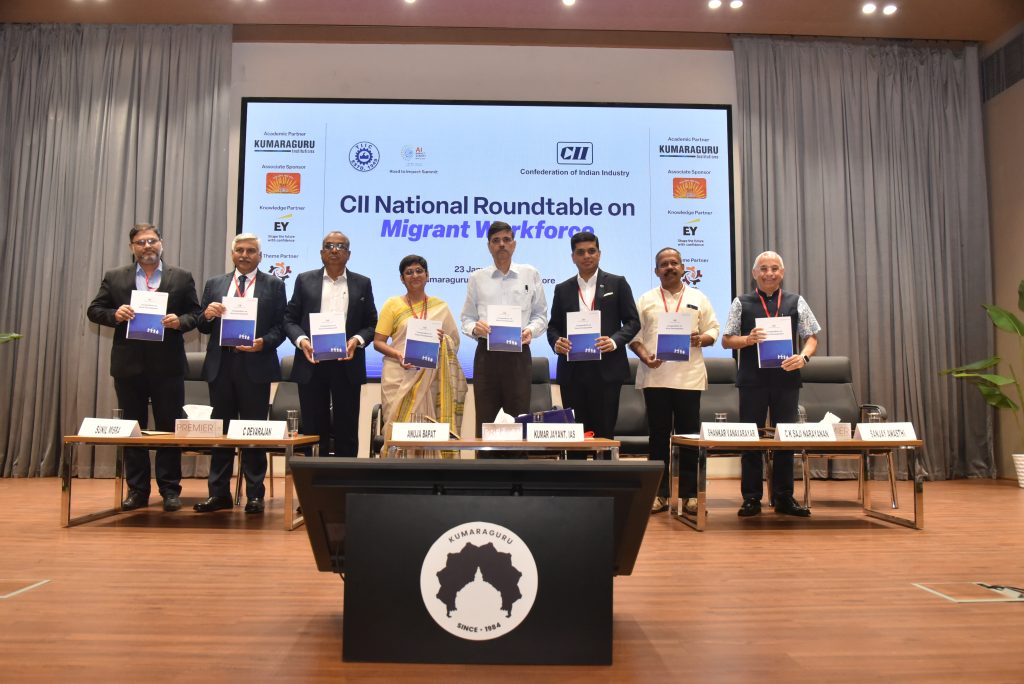
    The Confederation of Indian Industry (CII), in partnership with Kumaraguru Institutions, hosted a National Roundtable on Migrant Workforce on Friday at the Kumaraguru campus, bringing together senior government leaders, industry representatives, and international organisations to address one of India’s most pressing labour challenges—bridging the gap between policy intent and on-ground implementation.

    The roundtable witnessed participation from officials representing the Ministries of MSME, External Affairs, and Education, alongside global bodies such as the International Organization for Migration (IOM). Discussions centred on improving social security, recruitment practices, living conditions, and long-term dignity for India’s vast migrant workforce.

    The event was inaugurated by Kumar Jayant, IAS, Chairman and Managing Director of Tamil Nadu Industrial Investment Corporation Ltd. (TIIC). On the occasion, CII also unveiled the “CII Compendium on Industry Best Practices”, aimed at setting national benchmarks for responsible employment practices and migrant worker welfare.

    Migrant Workforce: “The Silent Backbone of India’s Growth Story”

    Delivering a special video address, Mansukh Mandaviya, Union Minister of Labour and Employment, described migrant workers as the “silent backbone of India’s growth story.”

    Emphasising a shift in national thinking, the Minister said migrant workers are no longer viewed merely as a labour class, but as critical contributors to India’s economic engine.

    Highlighting transformative government initiatives, Shri Mandaviya cited the success of the One Nation One Ration Card scheme, the e-Shram portal for workforce database management, and the expansion of social security coverage. However, he acknowledged the road ahead, stating candidly that “we still have a lot of work to do.”

    He underlined the importance of platforms such as the CII roundtable, noting that dialogue between industry and labour stakeholders is essential for meaningful policy advocacy. Inputs from such discussions, he said, are vital to bridge the gap between policy frameworks and ground realities.

    Calling the needs of migrant workers “multidimensional,” the Minister stressed that achieving the vision of Viksit Bharat by 2047 will require coordinated action across ministries.

    Call for a National Policy Shift

    Setting the tone for the day, Shankar Vanavarayar, Chairman of the CII National Task Force on Rural Development & Migrant Workforce, called for a fundamental shift in how India supports its migrant labour population.

    He stressed that improving migrant workforce conditions is a shared responsibility across borders, sectors, and institutions, adding that the treatment of migrant workers reflects the values of the nation as both a society and an economy.

    Highlighting the significance of the roundtable, Shri Vanavarayar described it as a “maiden attempt” to initiate a structured national dialogue, with plans to expand discussions across diverse geographies. He pointed out that workforce realities differ regionally, demanding a decentralised and context-sensitive approach to policymaking.

    “Migration Is Structural, Not Temporary”

    Speaking at the roundtable, Sanjay Awasthi, Head of Office, IOM, asserted that internal migration in India is “structural, not temporary,” forming the backbone of the country’s industrial growth.

    Advocating a move from informal to formal recruitment systems, he called for adoption of the global Employer Pays Principle, emphasising that recruitment costs should be borne by employers to prevent debt-driven exploitation.

    Mr. Awasthi outlined four strategic imperatives for industry:

    • transparent recruitment contracts in workers’ native languages,
    • focused interventions for women migrants,
    • stringent occupational safety standards, and
    • portability of social security benefits.

    “Migrant Workers Remain Invisible”

    Echoing concerns around visibility and protection, CK Saji Narayanan, former National President of Bharatiya Mazdoor Sangh (BMS), called for the “universalization of labour protection” to reach India’s last worker.

    Referring to lessons from the pandemic, he noted that migrant workers continue to remain largely invisible, lacking accurate data and access to basic safety nets. Urging a shift from “conflict to confluence” in industrial relations, he appealed to employers to view workers as extended family members.

    While welcoming the portability of social security benefits mentioned in the G20 declaration, Mr. Narayanan stressed that implementation remains the real challenge. He advocated mandatory appointment letters and worker registration across establishments, irrespective of size, to ensure dignity, safety, and visibility.

    Addressing Distress Migration Through Local Enterprise

    Bringing a policy and data-driven perspective, Anuja Bapat, Deputy Director General, Ministry of MSME, highlighted the critical difference between “aspirational migration” and “distress migration.”

    Drawing from her experience with the National Sample Survey, she observed that while skilled migration fuels growth, distress migration often creates deep social and economic challenges. She noted that most workers prefer migrating to the nearest possible location, rather than far-off destinations.

    Ms. Bapat urged policymakers to expand the definition of migrants to include dependent migrants—particularly women and children—whose needs often go unaddressed. Citing industrial hubs such as Surat, she explained how migrant workers frequently face higher per-capita living costs due to limited access to bulk purchasing and shared services.

    Positioning MSMEs as key enablers, she highlighted that with nearly 7.5 crore enterprises registered on the Udyam portal, the sector can serve as a powerful platform for skilling and stabilising livelihoods. Promoting local entrepreneurship through schemes like PM Vishwakarma, she argued, could create sustainable opportunities in home states and significantly reduce distress-driven migration.