Coimbatore:
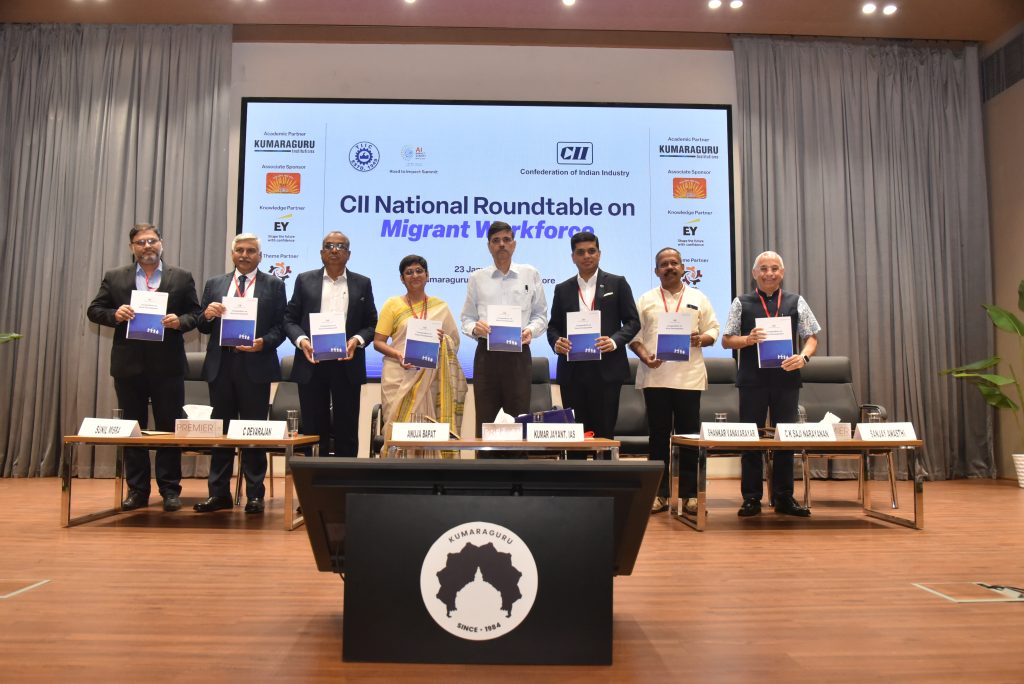
The Confederation of Indian Industry (CII), in partnership with Kumaraguru Institutions, hosted a National Roundtable on Migrant Workforce on Friday at the Kumaraguru campus, bringing together senior government leaders, industry representatives, and international organisations to address one of India’s most pressing labour challenges—bridging the gap between policy intent and on-ground implementation.
The roundtable witnessed participation from officials representing the Ministries of MSME, External Affairs, and Education, alongside global bodies such as the International Organization for Migration (IOM). Discussions centred on improving social security, recruitment practices, living conditions, and long-term dignity for India’s vast migrant workforce.
The event was inaugurated by Kumar Jayant, IAS, Chairman and Managing Director of Tamil Nadu Industrial Investment Corporation Ltd. (TIIC). On the occasion, CII also unveiled the “CII Compendium on Industry Best Practices”, aimed at setting national benchmarks for responsible employment practices and migrant worker welfare.
Migrant Workforce: “The Silent Backbone of India’s Growth Story”
Delivering a special video address, Mansukh Mandaviya, Union Minister of Labour and Employment, described migrant workers as the “silent backbone of India’s growth story.”
Emphasising a shift in national thinking, the Minister said migrant workers are no longer viewed merely as a labour class, but as critical contributors to India’s economic engine.
Highlighting transformative government initiatives, Shri Mandaviya cited the success of the One Nation One Ration Card scheme, the e-Shram portal for workforce database management, and the expansion of social security coverage. However, he acknowledged the road ahead, stating candidly that “we still have a lot of work to do.”
He underlined the importance of platforms such as the CII roundtable, noting that dialogue between industry and labour stakeholders is essential for meaningful policy advocacy. Inputs from such discussions, he said, are vital to bridge the gap between policy frameworks and ground realities.
Calling the needs of migrant workers “multidimensional,” the Minister stressed that achieving the vision of Viksit Bharat by 2047 will require coordinated action across ministries.
Call for a National Policy Shift
Setting the tone for the day, Shankar Vanavarayar, Chairman of the CII National Task Force on Rural Development & Migrant Workforce, called for a fundamental shift in how India supports its migrant labour population.
He stressed that improving migrant workforce conditions is a shared responsibility across borders, sectors, and institutions, adding that the treatment of migrant workers reflects the values of the nation as both a society and an economy.
Highlighting the significance of the roundtable, Shri Vanavarayar described it as a “maiden attempt” to initiate a structured national dialogue, with plans to expand discussions across diverse geographies. He pointed out that workforce realities differ regionally, demanding a decentralised and context-sensitive approach to policymaking.
“Migration Is Structural, Not Temporary”
Speaking at the roundtable, Sanjay Awasthi, Head of Office, IOM, asserted that internal migration in India is “structural, not temporary,” forming the backbone of the country’s industrial growth.
Advocating a move from informal to formal recruitment systems, he called for adoption of the global Employer Pays Principle, emphasising that recruitment costs should be borne by employers to prevent debt-driven exploitation.
Mr. Awasthi outlined four strategic imperatives for industry:
- transparent recruitment contracts in workers’ native languages,
- focused interventions for women migrants,
- stringent occupational safety standards, and
- portability of social security benefits.
“Migrant Workers Remain Invisible”
Echoing concerns around visibility and protection, CK Saji Narayanan, former National President of Bharatiya Mazdoor Sangh (BMS), called for the “universalization of labour protection” to reach India’s last worker.
Referring to lessons from the pandemic, he noted that migrant workers continue to remain largely invisible, lacking accurate data and access to basic safety nets. Urging a shift from “conflict to confluence” in industrial relations, he appealed to employers to view workers as extended family members.
While welcoming the portability of social security benefits mentioned in the G20 declaration, Mr. Narayanan stressed that implementation remains the real challenge. He advocated mandatory appointment letters and worker registration across establishments, irrespective of size, to ensure dignity, safety, and visibility.
Addressing Distress Migration Through Local Enterprise
Bringing a policy and data-driven perspective, Anuja Bapat, Deputy Director General, Ministry of MSME, highlighted the critical difference between “aspirational migration” and “distress migration.”
Drawing from her experience with the National Sample Survey, she observed that while skilled migration fuels growth, distress migration often creates deep social and economic challenges. She noted that most workers prefer migrating to the nearest possible location, rather than far-off destinations.
Ms. Bapat urged policymakers to expand the definition of migrants to include dependent migrants—particularly women and children—whose needs often go unaddressed. Citing industrial hubs such as Surat, she explained how migrant workers frequently face higher per-capita living costs due to limited access to bulk purchasing and shared services.
Positioning MSMEs as key enablers, she highlighted that with nearly 7.5 crore enterprises registered on the Udyam portal, the sector can serve as a powerful platform for skilling and stabilising livelihoods. Promoting local entrepreneurship through schemes like PM Vishwakarma, she argued, could create sustainable opportunities in home states and significantly reduce distress-driven migration.
Leave a Reply